A Look at Democratic Presidential Hopefuls’ Healthcare Ideas
Unlike the crowded Republican primary field heading into this year’s presidential election, just three candidates seek the Democratic nomination: former First Lady and former New York Sen. Hillary Clinton, former Maryland Gov. Martin O’Malley, and U.S. Sen. Bernie Sanders of Vermont.
Although they share numerous ideas, the candidates also differ fundamentally in how they believe the American healthcare system should be run. And they stand in stark contrast to their Republican opponents.
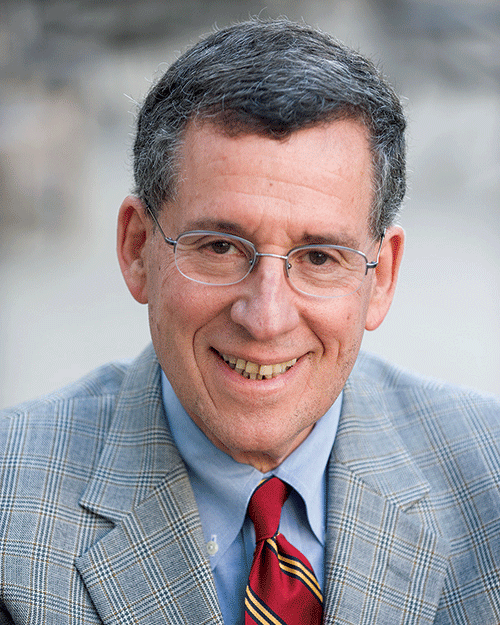
Dr. Blendon
“There really is a philosophical difference between the parties,” says Robert Blendon, professor of health policy and political analysis at the Harvard T.H. Chan School of Public Health and Harvard Kennedy School of Government. “Republicans really feel that if people themselves controlled more of the financial wherewithal, they would shop more and ask more questions.”
Democrats, however, “tend to believe that when people are ill, they are not in particularly good shape to shop,” Blendon says. Nor are they particularly fit to decide what costs are worth incurring or what procedures they may or may not need, he adds.
Listen to more of our interview with Dr. Blendon.
In general, Democrats believe the healthcare system should provide patients structure to make appropriate choices. They do not support reliance on high-deductible health plans and health savings accounts to lower healthcare costs.
“This is why the outcome of the election will matter,” Blendon says, “because it’s a very different view of what the future should look like.”
In 1993, as First Lady, Clinton undertook a failed but massive healthcare reform effort that would have created a universal healthcare system based on private insurance. Today, she supports the Affordable Care Act and says she will continue to build upon and support it, which includes making changes to the law such as repealing the Cadillac tax and further lowering out-of-pocket healthcare costs for most Americans.
Clinton’s view “is that many people have too large deductibles and copays, and for moderate-income people, it’s really deterring care,” Blendon says. “She’s likely to try to see if they can actually increase the government subsidies so the plans offer a wider range of benefits.”
Bradley Flansbaum, DO, MPH, MHM, hospitalist and SHM Public Policy Committee member, says changes must be made.
“We can’t say the direction we’re moving in is the right direction,” he says. “There is a desperate sense in America that what we have been doing is wrong and we need to change … whether the experiments now lead to a system more Americans would prefer remains to be seen.”
Sanders believes in a much bolder shift in direction. He does not think the Affordable Care Act goes far enough and wants to move to a single-payor system.
“I want to end the international embarrassment of the United States of America being the only major country on Earth that doesn’t guarantee healthcare to all people as a right, not a privilege,” he said at the second Democratic debate on Nov. 14, 2015.
However, his vision is unlikely to come to quick fruition if elected, Blendon says. “There’s not going to be—anywhere in the short term—the votes in the U.S. Congress to move in that direction.
“But it would change the level of discussion.”
O’Malley, on the other hand, wants to expand the ACA and envisions an “all-payor system” like that in Maryland, where the state sets medical costs and caps what hospitals can charge. He has vowed to continue to move away from a fee-for-service healthcare system and has said that reform should “eliminate the profit motive” for hospitals CEOs to keep beds filled.