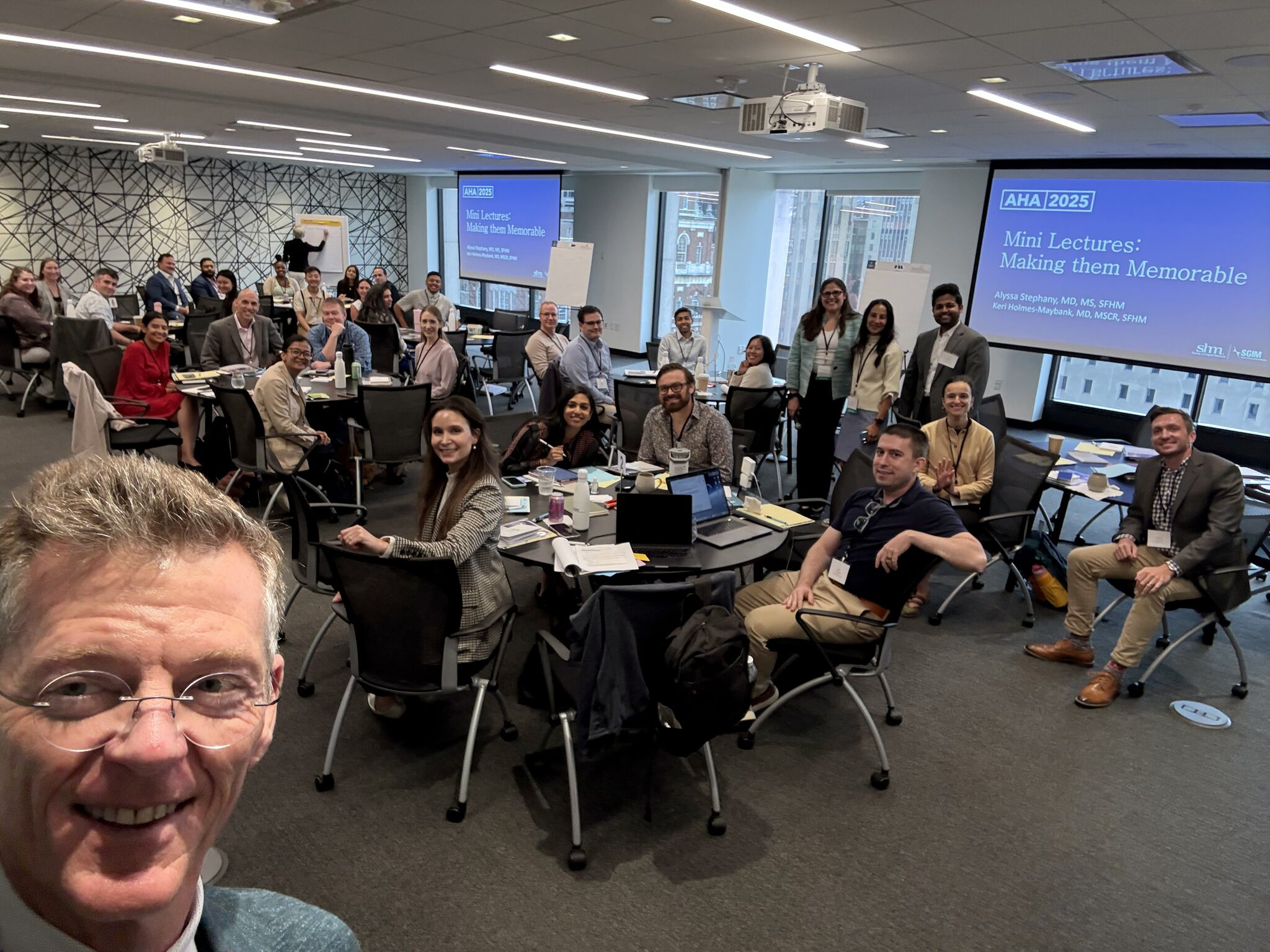
The September 2025 Academic Hospitalist Academy: Launching Your Career
In September 2025, I attended the Academic Hospitalist Academy: Launching Your Career, a four-day program designed for hospitalists who are interested in building or expanding their role in academic medicine. I had first heard about the program from my program director, an alumnus of the Academy, who recommended it as a valuable step for early-career academic hospitalists. The experience was one of the most fulfilling and practical learning experiences I have had in recent years, and I feel it would be a great course for others early in their academic journey.
The program, developed by SHM and the Society of General Internal Medicine, brought together early-career hospitalists from around the country who share a passion for teaching, mentorship, and professional growth. The goal was not to teach clinical medicine, but rather to equip and reinforce essential skills to be a more effective teacher and contributor to academics. The sessions focused on real-world topics that matter to all of us who balance patient care with education.
There were several sessions each day, and topics included tips on how to teach effectively on busy inpatient services, giving feedback that resonates, making bedside rounds more engaging for learners, understanding the basics of funding and business drivers of academic medical centers, and learning the basics of quality improvement and patient safety. There was also a strong emphasis on developing scholarship from our day-to-day work and understanding the process of academic promotions.
Participants included hospitalists from a wide range of institutions, large academic medical centers, community hospitals, and hybrid systems, all seeking to become more effective educators and mentors while balancing busy clinical roles. The faculty were experienced academic hospitalists who not only shared strategies and guidance but also discussed frankly the challenges they faced on their own journeys. The result was a program that felt both practical and deeply personal, and the atmosphere throughout the week was collegial and laid back.
Lessons for Daily Teaching
The Academy emphasized teaching skills that could be applied to our learners immediately, and the faculty modeled ways to make teaching on rounds efficient and engaging, even during busy days. There were also breakout sessions where participants practiced giving six-minute lectures and received feedback from faculty and fellow participants.
Sessions also covered how to deliver effective feedback, including how to frame constructive comments in ways that learners could act upon. Attendees practiced techniques through role play and shared examples from their own experiences. The environment was supportive and collaborative, which allowed participants to exchange honest reflections on what has worked for them and what hasn’t.
Turning Clinical Work into Scholarship
One of the Academy’s central themes was that scholarship can emerge from the work we already do every day. Sessions focused on how to identify scholarly opportunities in quality-improvement projects, clinical innovations, and educational initiatives.
The faculty walked through the steps of developing an idea into a publication and selecting appropriate journals. They discussed the peer-review process and common pitfalls for early authors. The tone was realistic but encouraging, and scholarship was presented as achievable for anyone committed to sharing their work. The faculty also offered to remain in communication with participants to assist with or collaborate on scholarly work.
Understanding Promotion and Academic Growth
For many participants, the topic of academic promotion was one of the most difficult to navigate. At the Academy, the faculty reviewed common academic promotion pathways and strategies for how to approach promotion committees. They emphasized how teaching, mentorship, and service could all contribute meaningfully to academic advancement when properly documented.
Discussions covered how to align one’s personal goals with institutional expectations and how to communicate the value of our work to department leaders. The sessions also explored the importance of mentorship in navigating career advancement and maintaining professional satisfaction.
Mentorship and Professional Identity
Mentorship emerged as a recurring theme throughout the week. Faculty and participants discussed both sides of the relationship, how to find good mentors, and how to become one. The Academy also prompted reflection on professional identity and purpose. Through small-group discussions, we shared our personal reasons for pursuing academic work, whether it was a love of teaching, an interest in education research, or a desire to influence institutional culture. There were excellent sessions covering leadership practices, identifying and dealing with imposter syndrome in our learners and ourselves, and finding joy in our practice.
Leadership, Advocacy, and the Business of Hospital Medicine
In addition to teaching and scholarship, the Academy addressed the operational realities of hospital medicine. The faculty explained the economics of hospital medicine, the role of hospitalists in advancing institutional goals, and strategies for aligning academic and administrative priorities. This focus on the “business side” of academic hospital medicine added an important layer of realism to the program and underscored that academic success requires not only passion, but also self-advocacy and planning.
A Culture of Connection
What I appreciated most was how approachable the faculty were and the collaborative environment it created amongst the participants. Faculty spoke openly about their own paths and made an effort to learn our names and get to know our stories. The small group sessions allowed participants to have honest conversations about the struggles we face in our individual practices and to share ideas for addressing them as we return to our respective organizations. I met hospitalists from around the country who were at similar stages in their careers, and being able to share our struggles and goals helped us create strong connections in a short amount of time.
Bringing It Home
After returning to my home institution, I felt the Academy gave me practical tools I could immediately apply to teaching residents and students, as well as a long-term framework for academic growth. I left with a clearer vision of what kind of educator and mentor I want to become, and how to get there. If you’re wondering whether it would be worth your time or investment, I can honestly say this conference was one of the best I have ever attended.
For hospitalists nationwide who enjoy teaching or want to explore the academic side of hospital medicine, I would strongly encourage looking into this program. It is a wonderful opportunity to connect with like-minded colleagues, learn from national leaders, and walk away with a plan to build the career you want.
I am deeply grateful to my program director, Dr. Amanda Magee, an alumna of the Academy, for recommending the program and for her ongoing guidance and support. I would like to extend my sincere thanks to the faculty of the Academic Hospitalist Academy: Launching Your Career for their time, guidance, and generosity in sharing their experience. Special thanks to Drs. Neera Ahuja, Keri Holmes-Maybank, Christopher Bruti, Andrew Dunn, Christopher Jackson, Alyssa Stephany, and Brian Kwan for their outstanding teaching and mentorship throughout the week.

Dr. Choudry
Dr. Choudry is an academic hospitalist at MedStar Washington Hospital Center and an assistant professor of medicine at Georgetown University School of Medicine, both in Washington, D.C.