
Hospital medicine requires both clinical expertise and an understanding of healthcare systems. While some residency programs offer hospital medicine electives, including the Junior Hospitalist Elective offered at our institution (Cooper Medical School of Rowan University, in Camden, N.J.), medical students often receive limited exposure beyond required rotations. A significant challenge exists for fourth-year medical students (M4s) who seek to advance their clinical independence through sub-internships but face limited availability.1,2 This lack of early exposure and restricted opportunities prompted two junior faculty members to develop the sophomore hospitalist elective. Designed to introduce medical students to key aspects of hospital medicine, this elective was developed to provide hands-on experiences in patient care, interdisciplinary collaboration, and system-based practice. By addressing these challenges during medical school, the goal was to enhance students’ readiness for future training and careers in hospital medicine.
Solution Overview
The primary objectives of the sophomore hospitalist elective include enhancing clinical independence, building confidence in patient management, and fostering a deeper understanding of the hospitalist’s role on a direct care service. Key stakeholders in this initiative include medical students, hospitalist faculty, residency program leadership, and hospital administrators.
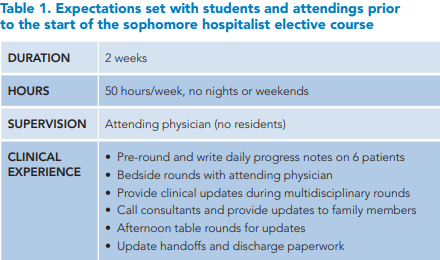
By engaging with experienced hospitalists, students gain insight into the challenges and rewards of this specialty, preparing themselves for more advanced clinical responsibilities in their training. The sophomore hospitalist elective was initially created to increase available internal medicine inpatient electives for fourth-year medical students in the 2023 to 2024 academic year. The inpatient teams at our hospital have one resident, one or two interns, one sub-intern, and two third-year medical students taking care of up to 14 patients. This often limits opportunities for the sub-interns to take on a census of more than three or four patients. On the other hand, each student in the sophomore hospitalist elective is assigned six patients to help instill confidence in clinical decision making of a larger patient census compared to their third year of medical school. Students are responsible for responding to messages from nurses, calling pharmacies, providing updates to family members, and updating discharge paperwork and handoffs. This hands-on responsibility is critical for developing autonomy, reinforcing the ability to synthesize medical knowledge, and improving efficiency in inpatient care settings.
There were three other important strategies in the development of the sophomore hospitalist elective. Our hospital has nine internal medicine inpatient teaching services, but also includes many other capable educators who are interested in engaging with students. This elective has created new opportunities for junior hospitalist attendings to gain experience with teaching students. For some fourth-year medical students deciding between internal medicine and another specialty, this elective provided valuable insight into the day-to-day responsibilities of an internal medicine resident and played a significant role in informing their final career choice. Finally, some students participated in this elective after the Match, providing a valuable opportunity to prepare for intern year.
Implementation Process
The sophomore hospitalist elective was developed approximately six months prior to implementation. It was approved by the medical school’s phase II subcommittee (for third- and fourth-year medical student courses) and the curriculum committee. Within two weeks of starting the elective, the students met virtually with one of the course directors to discuss expectations and workflow. Leading up to each student’s first day on the elective, the course directors emailed expectations to the hospitalist attendings (see Table 1) and made sure the hospitalist site directors and administrative staff were aware of the students rotating on the elective.
Of note, there were two obstacles the course directors encountered. At our institution, medical student notes cannot be cosigned for billable purposes, so attendings needed to adjust their workflows. In addition, in the summer months, there are new incoming interns, and many educational resources are devoted to them, but this is also a very popular time for the students to take the course. To address these obstacles, the course directors were able to lower the census of these teams by one to two patients to allow for increased time for teaching.
The program stands out because it did not require any compensation or reduction of clinical duties for the course directors or faculty. It has become a sustainable program that benefits students and hospitalist faculty without any additional resources or costs.
Outcomes and Impact
The sophomore hospitalist elective is a one-of-a-kind course designed to introduce the idea that hospitalists not only perform as clinicians, but also as leaders who aim to improve their hospital system. Creating opportunities for learners to interact one-on-one with attendings and increasing their clinical care responsibilities has received consistently positive feedback:
“I enjoyed and was grateful to have the kind of autonomy that I was given during this elective. I truly felt like I was months away from being a real doctor!”
“The clinical faculty I worked with were amazing and really knew the best ways to get me involved and more prepared for residency in ways that the general [internal medicine] sub-i[nternship] did not. I appreciate that they got me more involved in direct patient care, such as placing orders and reaching out to referrals. They also went out of their way to ensure I was being appropriately taught, and they really prioritized my education.”
“The sophomore hospitalist elective was amazing, and did an excellent job at giving insight into hospital medicine. One of the strengths is being able to see six patients throughout the week. By being able to go up to six patients, I was able to learn from each one and present all of them with a plan to my attending physician. Another strength is being able to pend orders and discuss different management protocols with my attending physician. This allowed me to specifically learn the insight into different order protocols and how to do them.”
Faculty members have also requested to rotate on this elective frequently:
“I think it’s a great elective to get 1:1 with a student. On a teaching team, there are so many people that it’s really hard to focus on a trainee’s strengths and weaknesses, so this is a great place to be able to do that. Sometimes it may add more work, but overall, I think that having a strong trainee makes your life easy and, honestly, fun. Sometimes direct care is a little lonely!”
“I had a great week on this rotation. I would certainly participate in this rotation again. “
“I think this is a good rotation— it’s still teaching but much less formalized with more rapid feedback and a collaborative environment. I structured rounds as me shadowing the student directly most days to directly observe their bedside manner, and this was well received by the student I worked with.”
The sophomore hospitalist elective has served 15 medical students during 30 elective weeks in two years, with 73% matching into internal medicine, notably 100% in the most recent year. In addition, the elective has developed into a reliable source of letters of recommendation for students. The first year, only one letter of recommendation was written; however, in the second year of the elective, seven letters of recommendation were written because of clinical interactions during this elective.
Lessons Learned
The sophomore hospitalist elective is an effective way to create new opportunities for fourth-year medical students to rotate with hospital medicine attendings as they try to gather letters of recommendation and finalize their chosen field for residency applications, despite limited sub-internship spots. The elective also gives students the chance to experience the workflow of a direct care service, which they would not otherwise see until they become attendings. This elective has also created teaching opportunities for junior faculty that they would not otherwise have. To sustain the program, the elective directors will continue to recruit junior faculty members and will expand the program as staffing continues to grow.
Future Directions
We plan to create and implement a survey about how this elective affects students’ perceptions of hospital medicine and future career plans. For students who match into internal medicine programs, we plan to track their career paths after residency to see if they decide to become hospitalists. We also plan to explore offering this program to third-year medical students during their spring elective period (we would call this the freshman hospitalist elective). We hope to create a model that not only supports students in making informed career decisions but also fosters enduring professional relationships.

Dr. Haroldson

Dr. Ortiz

Dr. Glickman
Dr. Haroldson is assistant program director for the internal medicine residency and co-site director for the division of hospital medicine at Cooper University Hospital, and an assistant professor of medicine at Cooper Medical School of Rowan University, both in Camden, N.J. Dr. Ortiz is PGY3 chief and internal medicine resident at Cooper Medical School of Rowan University, in Camden, N.J. Dr. Glickman is assistant clerkship director of the internal medicine clerkship and co-site director for the division of hospital medicine at Cooper University Hospital, and an assistant professor of medicine at Cooper Medical School of Rowan University, both in Camden.
Key Takeaways
- The sophomore hospitalist elective was created to provide more opportunities for fourth-year students to participate in sub-internship positions and to provide early exposure to hospital medicine.
- The elective focuses on enhancing clinical independence and confidence in patient management through direct patient care responsibilities and one-on-one supervision from attending physicians.
- The elective has shown success, with a high percentage of participating students matching into internal medicine and positive feedback from students, indicating its effectiveness in fostering interest and possibly preparing students for careers in the field.
- Future directions include tracking career paths post-residency, faculty development, and expanding the elective to third-year medical students
References
1. Lin D, et al. Implementation of a hospital medicine rotation and curriculum for internal medicine residents. MedEd-PORTAL. 2020;16:10977. doi: 10.15766/mep_2374-8265.10977.
2. Ludwin S, et al. Training residents in hospital medicine: the Hospitalist elective national survey. J Hosp Med. 2018;13(9):623- 625. doi: 10.12788/jhm.2952.