Menu Close
  • Clinical
    • In the Literature
    • Key Clinical Questions
    • Interpreting Diagnostic Tests
    • Coding Corner
    • Clinical
    • Clinical Guidelines
    • COVID-19
    • POCUS
  • Practice Management
    • Quality
    • Public Policy
    • How We Did It
    • Key Operational Question
    • Technology
    • Practice Management
  • Diversity
  • Career
    • Leadership
    • Education
    • Movers and Shakers
    • Career
    • Learning Portal
    • The Hospital Leader Blog
  • Pediatrics
  • HM Voices
    • Commentary
    • In Your Eyes
    • In Your Words
    • The Flipside
  • SHM Resources
    • Society of Hospital Medicine
    • Journal of Hospital Medicine
    • SHM Career Center
    • SHM Converge
    • Join SHM
    • Converge Coverage
    • SIG Spotlight
    • Chapter Spotlight
    • From JHM
  • Industry Content
    • Patient Monitoring with Tech
An Official Publication of
  • Clinical
    • In the Literature
    • Key Clinical Questions
    • Interpreting Diagnostic Tests
    • Coding Corner
    • Clinical
    • Clinical Guidelines
    • COVID-19
    • POCUS
  • Practice Management
    • Quality
    • Public Policy
    • How We Did It
    • Key Operational Question
    • Technology
    • Practice Management
  • Diversity
  • Career
    • Leadership
    • Education
    • Movers and Shakers
    • Career
    • Learning Portal
    • The Hospital Leader Blog
  • Pediatrics
  • HM Voices
    • Commentary
    • In Your Eyes
    • In Your Words
    • The Flipside
  • SHM Resources
    • Society of Hospital Medicine
    • Journal of Hospital Medicine
    • SHM Career Center
    • SHM Converge
    • Join SHM
    • Converge Coverage
    • SIG Spotlight
    • Chapter Spotlight
    • From JHM
  • Industry Content
    • Patient Monitoring with Tech

CDC: Opioid prescribing and use rates down since 2010

Trends in opioid prescribing and use from 2010 to 2016 offer some encouragement, but opioid-attributable deaths continued to increase over that period, according to the Centers for Disease Control and Prevention.
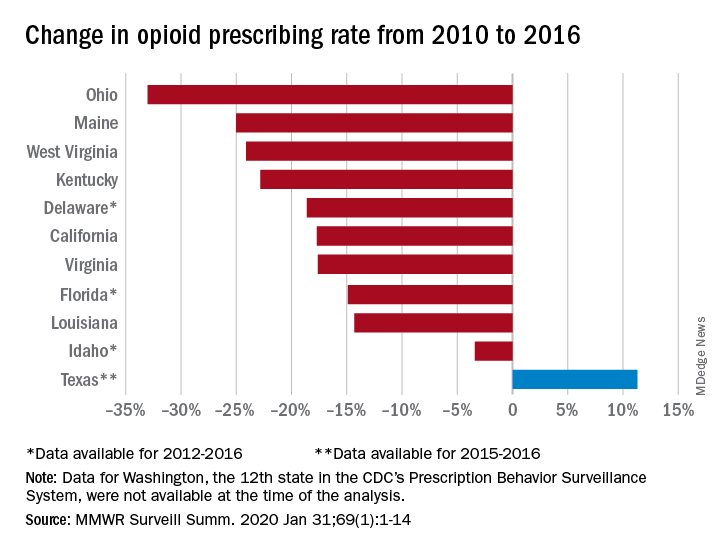
Change in opioid prescribing rate from 2010 to 2016

Prescribing rates dropped during that period, as did daily opioid dosage rates and the percentage of patients with high daily opioid dosages, Gail K. Strickler, PhD, of the Institute for Behavioral Health at Brandeis University in Waltham, Mass., and associates wrote in MMWR Surveillance Summaries.

Their analysis involved 11 of the 12 states (Washington was unable to provide data for the analysis) participating in the CDC’s Prescription Behavior Surveillance System, which uses data from the states’ prescription drug monitoring programs. The 11 states represented about 38% of the U.S. population in 2016.

The opioid prescribing rate fell in 10 of those 11 states, with declines varying from 3.4% in Idaho to 33.0% in Ohio. Prescribing went up in Texas by 11.3%, but the state only had data available for 2015 and 2016. Three other states – Delaware, Florida, and Idaho – were limited to data from 2012 to 2016, the investigators noted.

Related


Rural treatment of opioid use disorder increasingly driven by nonphysician workforce

As for the other measures, all states showed declines for the mean daily opioid dosage. Texas had the smallest drop at 2.9% and Florida saw the largest, at 27.4%. All states also had reductions in the percentage of patients with high daily opioid dosage, with decreases varying from 5.7% in Idaho to 43.9% in Louisiana, Dr. Strickler and associates reported. A high daily dosage was defined as at least 90 morphine milligram equivalents for all class II-V opioid drugs.

“Despite these favorable trends … opioid overdose deaths attributable to the most commonly prescribed opioids, the natural and semisynthetics (e.g., morphine and oxycodone), increased during 2010-2016,” they said.

It is possible that a change in mortality is lagging “behind changes in prescribing behaviors” or that “the trend in deaths related to these types of opioids has been driven by factors other than prescription opioid misuse rates, such as increasing mortality from heroin, which is frequently classified as morphine or found concomitantly with morphine postmortem, and a spike in deaths involving illicitly manufactured fentanyl combined with heroin and prescribed opioids since 2013,” the investigators suggested.

[email protected]

SOURCE: Strickler GK et al. MMWR Surveill Summ. 2020 Jan 31;69(1):1-14.
  • 1

    CDC: Opioid prescribing and use rates down since 2010

    January 31, 2020

  • 1

    WHO declares public health emergency for novel coronavirus

    January 30, 2020

  • 2019 Novel Coronavirus: Frequently asked questions for clinicians

    January 30, 2020

  • 1

    CDC: First person-to-person spread of novel coronavirus in U.S.

    January 30, 2020

  • 1

    Introduction to population management

    January 30, 2020

  • 1

    CDC: Risk in U.S. from 2019-nCoV remains low

    January 30, 2020

  • 1

    Quick Byte: EHRs and clinician wellness

    January 29, 2020

  • 1

    What 2019’s top five CAD trials tell us

    January 29, 2020

  • 1

    HHS: Coronavirus risk low in U.S., vaccine development underway

    January 28, 2020

  • 1

    Improving health care with simulation

    January 28, 2020

1 … 307 308 309 310 311 … 984
  • About The Hospitalist
  • Contact Us
  • The Editors
  • Editorial Board
  • Authors
  • Publishing Opportunities
  • Subscribe
  • Advertise
  • Copyright © 2026 by John Wiley & Sons, Inc. All rights reserved, including rights for text and data mining and training of artificial technologies or similar technologies.
    ISSN 1553-085X
  • Privacy Policy
  • Terms and Conditions
  • SHM’s DE&I Statement
  • Cookie Preferences